
What did this product cost to build?
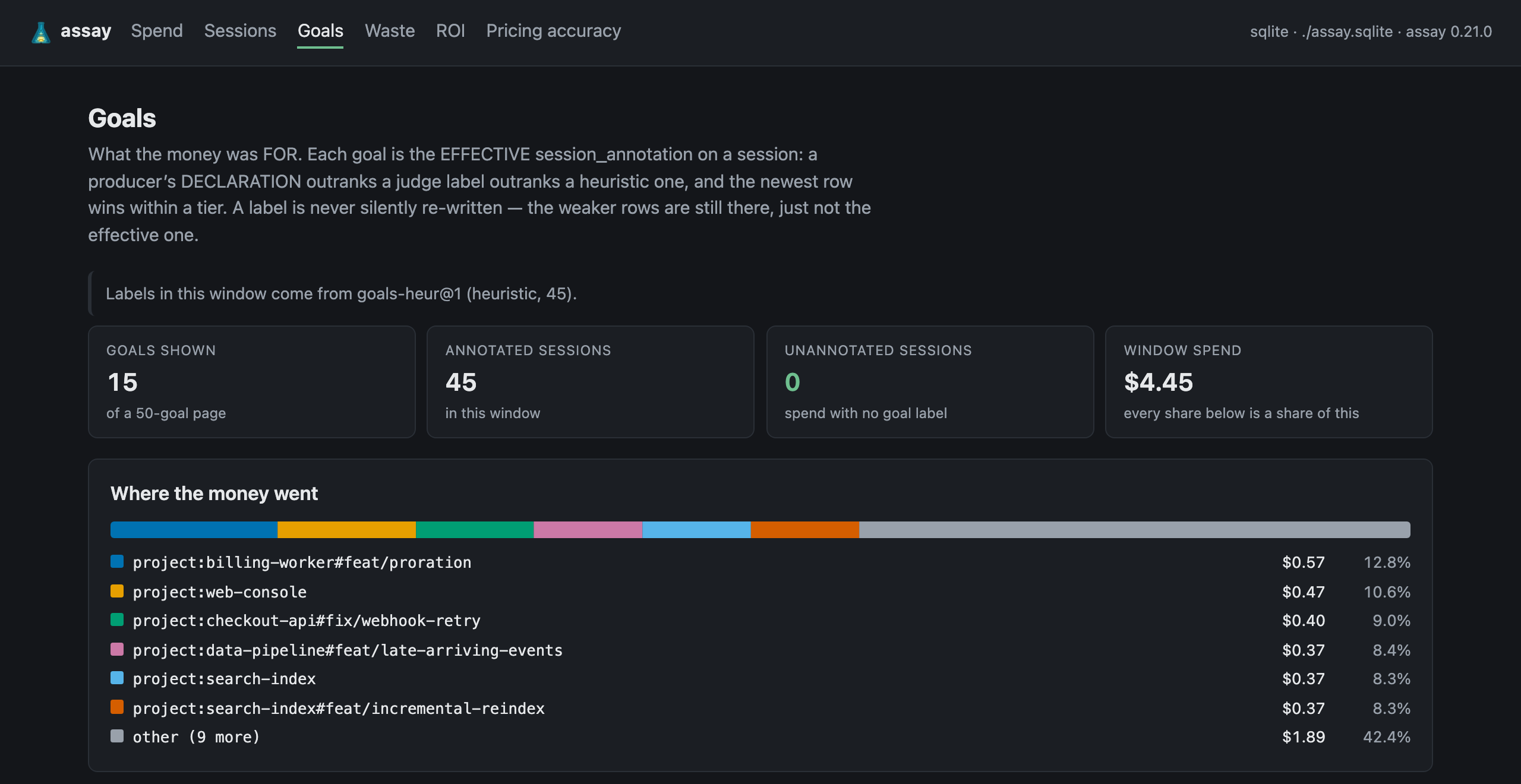
Spend attributed to the work that produced it — a product, a feature, a repo, a release. You get an upper bound and a partitioned estimate, both labelled, plus the spend it could not attribute at all.
Assays value, not just count
Your provider's bill is a total. Assay turns it into the numbers you can act on — cost per product, per feature, per customer, per outcome — on your own machine, joined to the work that caused it.
What Assay answers
An invoice is one number for the month. These are the numbers people actually make decisions with — and none of them can be recovered from an invoice, because the invoice never saw the work.
Spend attributed to the work that produced it — a product, a feature, a repo, a release. You get an upper bound and a partitioned estimate, both labelled, plus the spend it could not attribute at all.
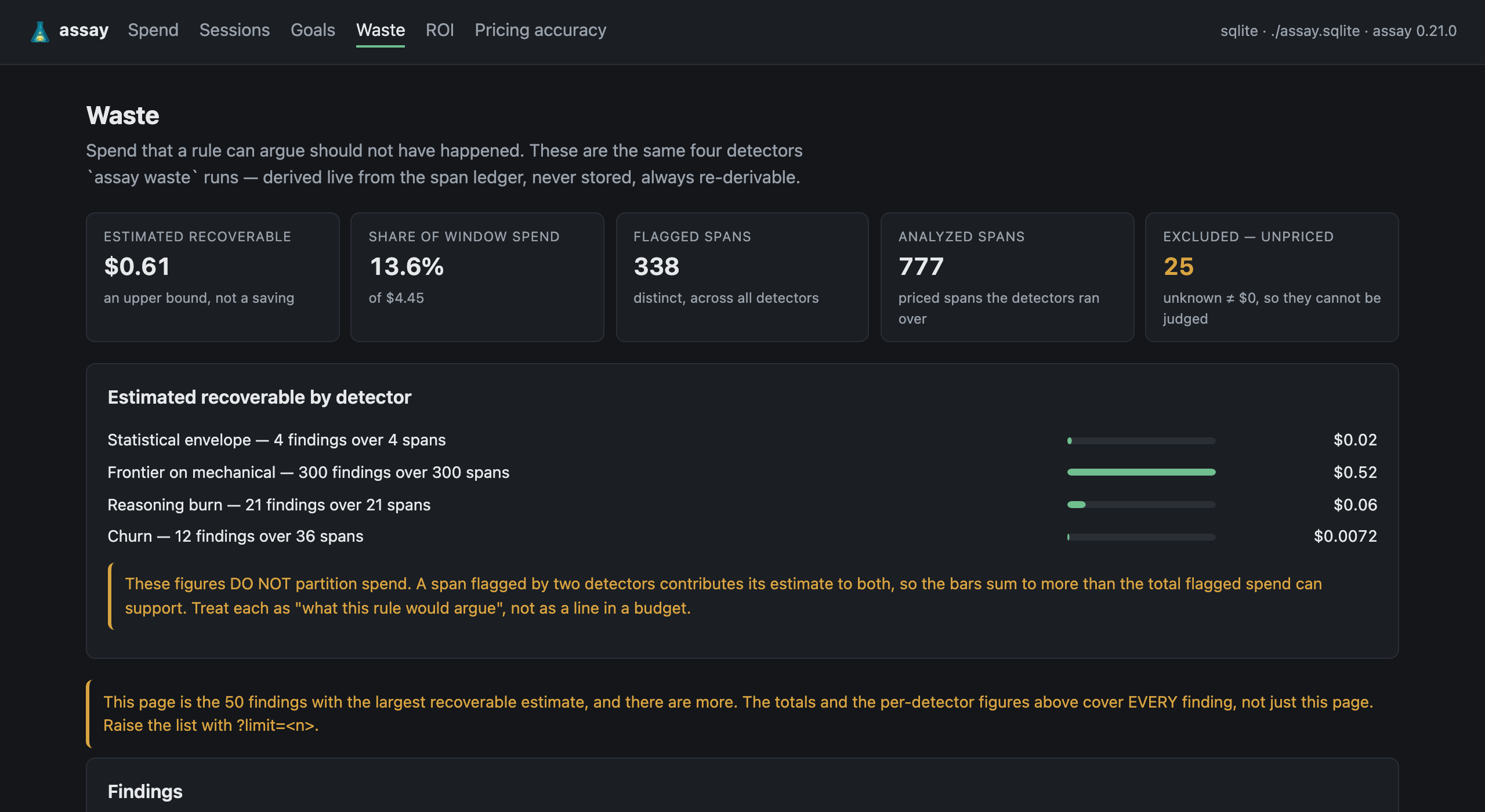
A frontier model doing mechanical work. A session that ran away overnight. A cache that quietly stopped being hit. Each one is flagged against your own ledger, and each one opens onto the conversation that spent the money.
Bind spend to the results it produced — a ticket resolved, a build shipped, a customer served — and read cost per outcome instead of cost per month. Where an outcome has no value declared, Assay says so rather than inventing one.
Meter AI usage inside your own product, per customer and per feature, on a ledger that records each unit of work exactly once. That is what makes it safe to put a charge on the other side of it.
Why not the billing page
Who it is for
One runaway loop, or one cache that quietly stopped being hit, multiplies the bill for weeks — and the provider's dashboard still shows a total that looks normal.
You need metering and attribution as a library rather than a vendor: per customer, per feature, on your own infrastructure, recorded once so a replayed event never charges twice.
You need a cost figure that can still be reproduced six months from now, and that survives the question of how it was derived.
Regulated, security-reviewed, or simply unwilling. "We are SOC 2" is not the same answer as "it never left the machine."
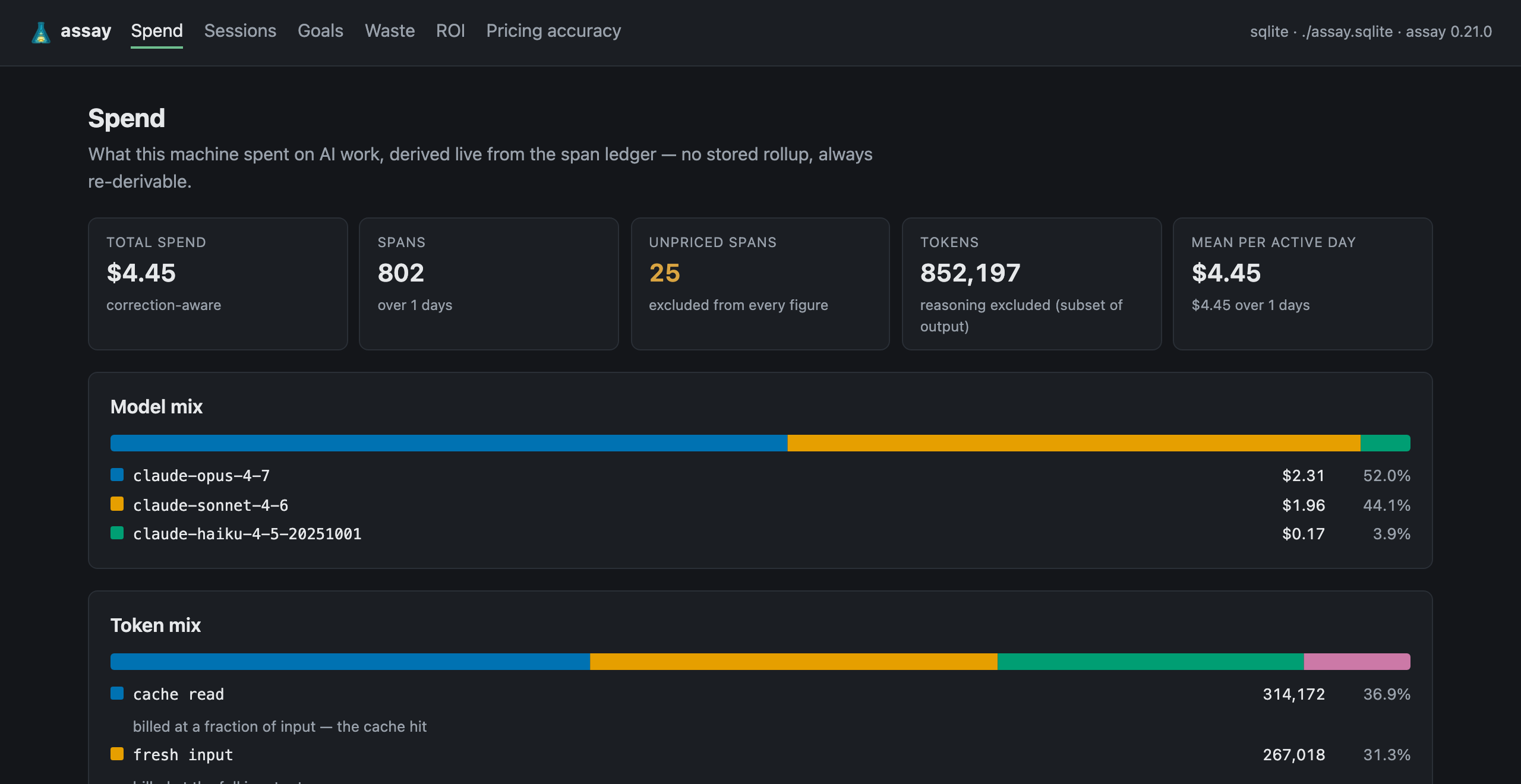
The console
A read-only console over your own store. It runs the same reports the command line runs, so the screen and the terminal can never report different numbers — and a panel only appears if your store can actually answer it.
Why you can trust the number
Assay is built to produce figures that survive a review — reproducible later, safe to bill from, and honest about their own limits.
Pricing is positioning
Free, under MIT: the ledger itself, the stores, the price table, and the capture. The money is the layer above it — attribution, valuation, waste, cost per outcome, the ingest door, and the console.
That line is not a marketing boundary. It is enforced by the build, which is why an eventual open-source release would be a move rather than an untangling.
The repository is private today. The MIT grant on the substrate is standing, so publication would be a visibility flip rather than a relicensing — but it has not happened.
It installs on your machine, reads the AI work your systems already did, and hands back the numbers a bill was never able to produce.